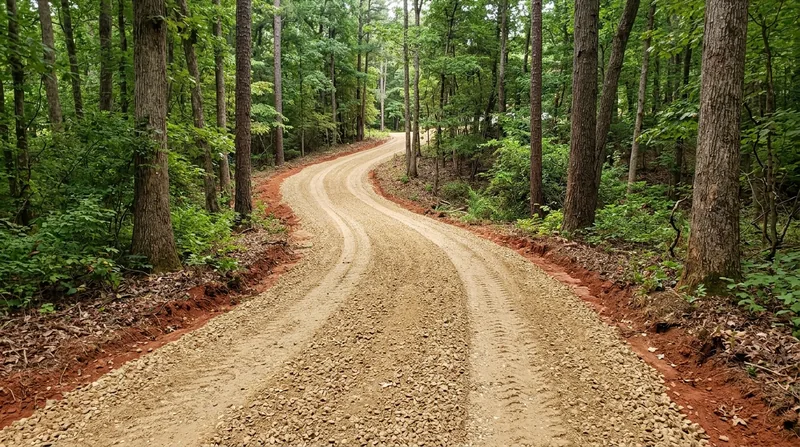




Gravel driveways across rural Durham and Chatham County work well until red clay traps water in the ruts, and then the real problem starts. The Piedmont soil here swells when wet and turns soft during long damp spells, so ruts deepen, the crown flattens, and water pools instead of running off. Gravel driveway installation and grading means reshaping that surface, adding fresh stone, and building back the slope so drainage works again. We measure the drive, regrade to proper pitch, add compacted stone, and crown it so rain moves off and into the shoulders instead of sitting in clay. A properly graded gravel drive can hold steady for two to three years in Durham's climate before you need another pass.
Why Gravel Driveway Regrading Matters in Durham's Red Clay Terrain
Durham's close-in neighborhoods and the rural belt stretching into Chatham County both rely on gravel for driveways where asphalt or concrete isn't practical or budgeted. The trouble is the Piedmont clay beneath it. This soil is dense, iron-rich, and it moves: it swells when water sits in it and shrinks when it dries, so a drive that was crowned properly in spring can develop low spots by July, and those low spots catch the next rain. The ruts grow deeper, the water stays longer, and the clay softens. Without regrading and fresh stone, a gravel drive becomes impassable or unsafe in wet weather.
- Regrading restores the crown so water runs off the surface instead of pooling in clay ruts.
- Fresh stone fills in the compacted base and gives you a clean, stable driving surface again.
- Proper pitch prevents standing water, which is the root cause of clay softening and washboard ruts.
- A well-crowned gravel drive holds up longer in Durham's wet springs and humid summers.
Regrading a gravel drive is cheaper than paving, and it buys you time to plan a long-term surface upgrade if that's in your future.
Key info: Durham County and Chatham County rural properties often have long gravel drives that serve as the only access. Regrading keeps them passable through the wet season and prevents the clay base from becoming impassable mud. A single regrading can last two to three years depending on traffic and rainfall.
For more information on surface options beyond gravel, see our asphalt driveway paving and installation page.
How We Regrade and Restore a Gravel Driveway in Durham
Gravel driveway regrading is straightforward field work. We arrive with a grader or skid steer, measure the drive length and width, evaluate the crown and drainage, and then remove the old compacted stone and clay, reset the base to proper pitch, and add new compacted stone. The goal is a slope of roughly 2 to 3 percent across the width so water sheds to the shoulders, and a gentle slope along the length so it runs downhill. We then proof-roll the base to make sure it's solid, add the stone layer, and crown it so it sheds water before it can pool.
- We measure the driveway and identify low spots, ruts, and areas where water pools.
- We remove the top layer of compacted stone and any soft or displaced clay.
- We regrade the subgrade to the proper slope, typically 2 to 3 percent across and downhill along the length.
- We add fresh compacted stone, usually 4 to 6 inches of crushed limestone or similar aggregate.
- We crown the surface so rain runs off immediately instead of sitting in the clay.
- We compact the stone layer so it bonds and resists rutting under traffic.
The whole job usually takes a day or two depending on the drive length and the condition of the base.
Example: A 200-foot gravel drive serving a rural property near Hillsborough had developed two inches of ruts in the center and standing water after rain. We regraded the entire drive, removed the soft clay, reset the crown, and added 5 inches of fresh crushed limestone. The drive is now passable year-round, and the homeowner expects another two to three years before the next regrading is needed.
If you are considering a longer-term surface, see our page on recycled asphalt and millings driveways, which offer a step up from plain gravel while still being budget-friendly.
Gravel Drive Regrading Methods and Stone Options
| Approach | Description | Best for |
|---|---|---|
| Full regrade with fresh stone | Remove old compacted stone, reset the subgrade to proper pitch, add new crushed limestone or granite, compact and crown. | Ruts deeper than 2 inches, standing water, or drives that have not been regraded in 3+ years. |
| Top-dress only | Add fresh stone to the existing base without full regrading, then crown and compact. | Drives with good subgrade and minor rutting or washboard, or maintenance between full regrades. |
| Crushed limestone | Angular, compactable stone that bonds well and resists rutting; the standard choice in the Piedmont. | Most rural Durham and Chatham County drives; compacts quickly and sheds water. |
| Recycled asphalt millings | Crushed asphalt mixed with stone; binds over time and creates a firmer surface than plain gravel. | Drives ready for a more durable surface than plain stone but not yet ready for full asphalt paving. |
Crushed limestone is the workhorse choice across Durham County because it compacts well, resists rutting under normal traffic, and sheds water when properly crowned. Recycled asphalt millings offer a step up in durability if you want the drive to last longer between maintenance passes.
Gravel Driveway Installation and Grading Cost in Durham: What to Expect
Gravel driveway regrading in Durham starts at around $950 for a short drive on good subgrade with minor work, and moves upward from there based on length, the amount of soft clay that needs removal, and how much new stone is required. A 200-foot drive with moderate ruts and decent base might run $1,200 to $1,800. A longer rural drive with heavy clay removal and new compacted base could reach $2,500 to $3,500. The key variables are drive length, the depth of ruts and soft spots, and whether the subgrade needs significant rework or just topping.
We provide written estimates with tonnage specs so you know exactly what stone is being added and how much work is involved. The estimate includes the measurement, the grading plan, the stone type and amount, and the labor. We do not charge for the estimate, and there is no obligation to book once you have the number.
See our pricing page for a full breakdown of costs and what moves each job up or down in price.
Gravel Driveway Installation and Grading Near Me: What Durham Homeowners Should Know When Hiring
Gravel driveway work is straightforward, but it pays to hire someone local who understands Piedmont clay and Durham's weather patterns. When you are looking for a contractor near Durham, ask for references from previous gravel work, request a written estimate with stone tonnage and measurements, and verify that they understand local drainage and the crown pitch your drive needs. Some properties in Durham require a permit for driveway work, especially if the drive extends into the right-of-way or if there is a culvert or drainage structure involved, so a good contractor will help you understand what your local building department requires.
- Ask for a written estimate that includes drive measurements, stone type and tonnage, and the work scope.
- Request references from recent gravel driveway regrading jobs in Durham or nearby.
- Verify that the contractor is fully insured, and ask to see the certificate if you have any doubt.
- Understand your local permitting rules by contacting the Durham County Planning Department or your municipality's building office before you book.
- Confirm that the contractor knows how to establish proper crown and pitch so your drive sheds water and stays passable.
Hiring a local contractor who has worked in Durham's clay and knows the seasonal challenges is the best way to get a driveway that holds up and stays accessible year-round.
Ready to move forward? Contact us for a free estimate at (984) 257-4541. We respond within 24 hours and provide a detailed written quote with no obligation.
Gravel Driveway Installation & Grading in Durham: Pricing Guide
| Service | Price | Details |
|---|---|---|
| Short gravel driveway regrading (under 150 feet) | Starting at $950 | Includes measurement, minor regrading, fresh stone, crown and compaction for short residential drives |
| Medium gravel driveway regrading (150 to 300 feet) | Starting at $1,400 | Full regrade, subgrade evaluation, fresh compacted stone, crown and drainage work for typical rural Durham drives |
| Long or complex gravel driveway regrading (300+ feet or heavy clay removal) | Starting at $2,200 | Extensive regrading, soft clay removal, compacted base preparation, fresh stone layer, multiple passes and proof rolling |
| Top-dress maintenance (gravel only, no regrading) | Starting at $650 | Fresh stone added to existing base without subgrade work, for maintenance between full regrades |
| Travel and estimate | Included | No mileage charge within Durham and surrounding service areas, free written estimate within 24 hours |
Indicative pricing, the exact cost depends on square footage, finish, and site access. Free personalized estimate within 24h at (984) 257-4541.


