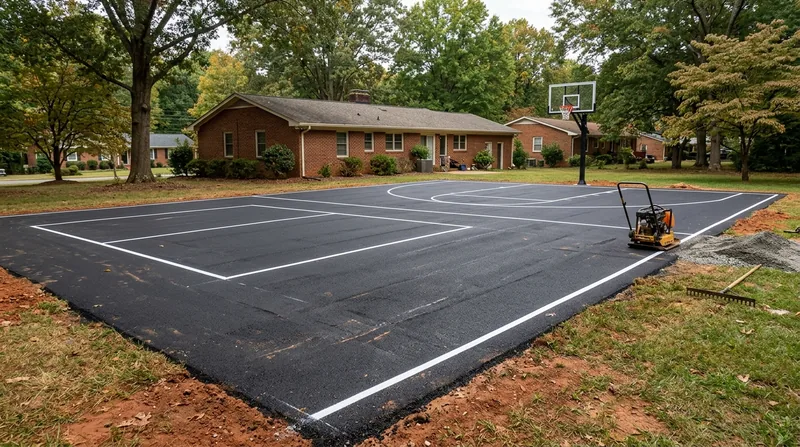




A sports court or recreational path in Durham sits on the same dense, iron-rich Piedmont clay that moves every driveway in the region. When wet, this soil swells; when dry, it contracts. A tennis court, basketball court, or walking path that isn't built on a properly compacted base will heave, settle, and crack within a season or two. We grade for positive drainage, compact the subgrade tight enough to resist movement, and finish with a smooth asphalt surface that stays level through wet spells and summer heat. The result is a court or path that plays true and lasts.
Why Proper Base Preparation Matters for Sports Courts in Durham
A basketball court or tennis court demands a surface that is dead flat and stable. The Piedmont clay beneath most Durham properties is not stable on its own. Without proper grading and compaction, the ground moves with the seasons, and any surface laid on top of it will follow. Asphalt, which is flexible but not rigid, will crack and settle. A court that was level in spring may be humped or dished by fall. The fix is base-first construction: we grade away standing water, compact the subgrade in lifts with a proof roller, and build a stable platform before the asphalt goes down.
- Grade the site to shed water away from the court or path, preventing pooling and subsurface saturation.
- Compact the clay and aggregate base in multiple passes until it resists movement under load.
- Set a compacted stone base course, typically 4 to 6 inches, as the working platform for asphalt.
- Lay the asphalt surface course smooth and level, with a slight crown for drainage if the court is large.
Courts and paths built this way hold their surface and remain playable through Durham's wet winters and hot, humid summers.
Key info: A residential basketball court in Chapel Hill or a walking path at a Durham HOA community that settles or cracks within the first year almost always failed at the base preparation stage. Proper compaction costs more upfront but eliminates the most common cause of premature failure.
For guidance on whether your property's soil and drainage are suitable for a court or path, and what local grading or stormwater rules apply, check with the Durham city engineering office or your local building department before you start.
How We Build Sports Courts and Paths: Step by Step
The process begins with a site visit to evaluate drainage, soil condition, and the intended use of the court or path. We measure the area, identify high and low spots, and determine what grading is needed to move water off the surface. From there, we follow a proven sequence: clear and rough grade, compact the subgrade, place and compact a stone base, then finish with asphalt. Each step matters. Rushing or skipping any of them is how courts fail.
- Survey the site and identify drainage problems, soft spots, and soil type.
- Clear vegetation and rough-grade the area to establish proper slope and remove standing water sources.
- Proof-roll the prepared subgrade with a heavy roller to verify compaction and find any soft spots.
- Place a compacted aggregate base course, typically 4 to 6 inches of crushed stone, and proof-roll again.
- Lay the asphalt surface in one or two lifts, finishing it smooth and level with the correct crown for drainage.
- Mark lines if the court is for tennis or basketball, or leave the path plain depending on use.
The entire process for a standard residential court takes one to two days on site, depending on the size and the amount of grading needed.
Local example: A Cary homeowner wanted a 2,000-square-foot basketball court in a backyard that sloped toward the house. We regraded the site to slope away, compacted the clay and a 5-inch stone base, and finished with 2 inches of asphalt. The court stayed level and playable for years because the base was done right the first time.
If you are planning a court or path on a property with existing drainage issues or uncertain soil, contact us for a free estimate so we can assess the site in person and explain what the ground will require.
Sports Court and Path Construction Methods
| Approach | Description | Best For |
|---|---|---|
| Full-depth asphalt court | Compacted clay subgrade, 4 to 6 inches of stone base, 2 to 3 inches of asphalt finished smooth and level. | Basketball courts, tennis courts, and recreational paths where durability and a true playing surface are required. |
| Recycled asphalt base with new surface | Compacted recycled asphalt millings as the base layer, topped with 2 inches of new hot mix asphalt for a smooth finish. | Budget-conscious courts where recycled material is available and a smooth, playable surface is the priority. |
| Tar and chip path | Compacted stone base with a binder and stone chip surface, creating a rustic, permeable finish. | Walking paths and light-use recreational areas where a natural appearance and lower cost are acceptable. |
| Gravel path with proper drainage | Compacted clay subgrade, 4 to 6 inches of crushed stone, raked and crowned for drainage, no asphalt or tar binder. | Rural properties and walking trails where a simple, permeable surface is sufficient and maintenance is acceptable. |
Each method begins with the same foundation: proper grading and compaction. The choice depends on use, budget, and how long you want the surface to last without maintenance.
Sports Court and Path Paving Cost in Durham: What to Expect
A residential sports court or path starts at around $8,500 for a small court on well-drained land with minimal grading. That price covers the site work, compacted base, and a smooth asphalt finish. Larger courts, sites that require significant regrading, or properties with poor drainage or challenging soil will cost more. A 2,000-square-foot basketball court with moderate site preparation typically runs $12,000 to $16,000. A walking path of 100 to 200 linear feet might be $4,000 to $6,000. The real variables are the size of the area, how much earth moving and compaction the site demands, and whether utilities or structures complicate the work.
The best way to know the cost for your property is to get an estimate. We measure the site, assess the soil and drainage, and give you a written quote that includes tonnage and thickness specs so you know exactly what you are paying for. Visit our pricing page for more detail on how we structure estimates, or call us at (984) 257-4541 for a free, no-obligation site visit.
Sports Court and Path Paving Near Me: What Durham Homeowners Should Know
Before you hire anyone to build a sports court or path on your property, verify that the contractor understands site drainage and base preparation, can provide references from similar projects, and will give you a written estimate that includes base depth, asphalt thickness, and the total tonnage. Check whether your city or HOA has rules about recreational surfaces, impervious-surface limits, or stormwater management that apply to your court or path. In Durham and most surrounding towns, a sports court or path may require a permit, especially if it involves grading, fill, or changes to drainage. Confirm with your local building department before work starts.
- Ask for references from at least two similar court or path projects the contractor has completed in the past three years.
- Request a written estimate that lists base material, base depth, asphalt thickness, total tonnage, and the cost per phase.
- Confirm that the contractor is fully insured and will carry insurance for the duration of the job.
- Check whether your HOA or municipality requires a permit or architectural approval before construction begins.
- Verify that the contractor understands North Carolina utility locating rules and will call 811 before any excavation.
A contractor who rushes the base work, offers a price that seems too low, or asks for a large cash deposit upfront is a red flag. The foundation of a sports court is everything; if it is not done right, the surface will fail. Contact us to discuss your court or path project and get a straightforward estimate based on your site conditions.
Sports Court & Path Paving in Durham: Pricing Guide
| Service | Price | Details |
|---|---|---|
| Small residential path (100-200 linear feet) | Starting at $4,000 | Grading, 4-inch compacted stone base, 2 inches asphalt, includes site prep and minor drainage work |
| Standard basketball or tennis court (2,000 sq ft) | Starting at $8,500 | Subgrade prep, 5-inch stone base, 2-inch asphalt surface, marking lines, on well-drained level sites |
| Court with significant grading or poor drainage | Starting at $12,000 | Regrading, compaction, 6-inch base course, drainage swales, 2-inch asphalt, soil conditions drive final cost |
| Large court or complex site (3,000+ sq ft or challenging terrain) | On estimate | Site-specific assessment required; slope, soil type, utilities, and existing structures determine labor and material |
| Travel | Included | No mileage fee within Durham and surrounding service area, included in all quotes |
| Free estimate | Free | Site visit, written quote with specs, no obligation; response within 24 hours at (984) 257-4541 |
Indicative pricing, the exact cost depends on square footage, finish, and site access. Free personalized estimate within 24h at (984) 257-4541.


