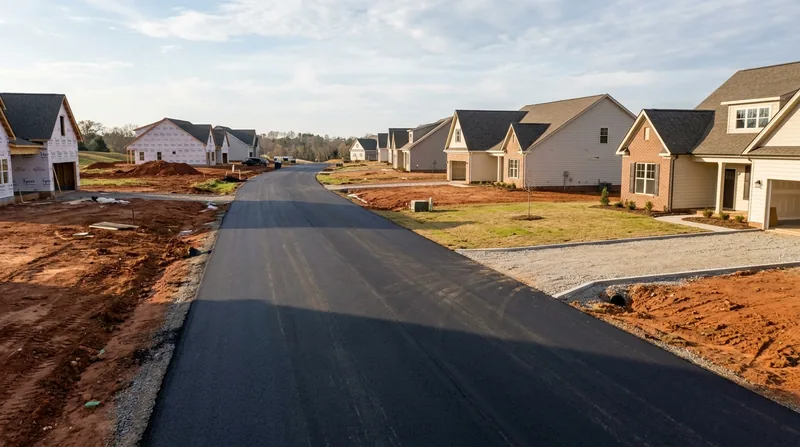




Private Road & HOA Paving in Durham requires a foundation built for Piedmont clay and the traffic loads that subdivisions generate. Durham's terrain slopes through older mill-village neighborhoods and post-war ranch rings before spreading into newer master-planned communities across the Triangle, each phase cut straight into red clay that swells when wet and softens through humid summers. A shared road or HOA driveway that hasn't been graded and compacted properly will heave, crack, and fail under the weight of multiple vehicles and the seasonal movement of the clay beneath it. We grade, compact, and pave private roads and HOA sections so the surface handles subdivision traffic, wet-season clay movement, and the freeze-thaw cycles that Durham sees through winter. The difference between a durable shared road and one that fails in five years is the base: compacted aggregate, proper pitch to shed water, and asphalt laid to thickness and specification.
Why Private Roads and HOA Paving Matter in Durham
A private road or HOA-maintained driveway carries traffic from multiple households and must be built to a higher standard than a single-family driveway. Piedmont clay is dense, iron-rich, and prone to movement when water sits in it, which is exactly what happens under a poorly pitched or inadequately compacted road. Cracking starts within a year or two, potholes follow, and the cost to repair spreads across the entire HOA or private road association. The right approach from the start saves thousands in repairs down the line.
- We grade and compact the subgrade to eliminate settlement and heave caused by clay movement under load.
- We install a compacted aggregate base thick enough to distribute traffic loads evenly and prevent edge failures.
- We pitch the surface to shed water quickly so it doesn't sit in the asphalt or the clay below.
- We specify asphalt thickness and tonnage so the road holds up to shared-use traffic and seasonal weather cycles.
- We pull North Carolina 811 utility locates before any excavation to protect buried lines.
A well-built private road or HOA driveway will serve reliably for ten to fifteen years with routine maintenance and no major repairs.
Key info: HOA architectural standards and local building codes vary across the Triangle. Chapel Hill, Cary, Raleigh, and Durham each have different permitting requirements for private roads, driveway aprons, and curb cuts. We help you navigate those requirements and coordinate with your local building department and HOA board before we begin work. See the contact page to discuss your specific project.
How We Build Private Roads and HOA Driveways in Durham
The process starts with a site visit to understand the terrain, drainage, clay behavior, and traffic load. We measure the road, check the existing grade, and identify where water pools or where the clay is moving. From there, we specify the base, the asphalt thickness, and the pitch needed to make the road work in Durham's climate and soil. Every estimate includes written tonnage and thickness so you know exactly what you're getting.
- We conduct a site walk to evaluate terrain, clay conditions, drainage patterns, and existing surface condition.
- We measure the road and calculate the square footage, then determine the base depth and asphalt thickness needed for the traffic load.
- We pull utility locates through North Carolina 811 to identify buried lines before any excavation.
- We grade the subgrade and compact it to eliminate settlement and clay-driven movement.
- We install and compact the aggregate base layer in lifts to the specified thickness.
- We proof-roll the base to confirm it will support the asphalt and traffic loads without settling.
- We lay hot mix asphalt at the specified thickness, compact it, and pitch it to shed water.
- We deliver a written estimate with tonnage, thickness, and timeline before any work begins.
The entire process is transparent and built on the compaction and base preparation that makes the road last.
Real example: A ten-unit HOA in Durham's north side had a private road that was cracking badly after five years. The original contractor had graded and paved without compacting the subgrade, and the Piedmont clay was moving under the light traffic load. We removed the failed asphalt, recompacted the clay subgrade, installed a proper aggregate base, and laid new asphalt at the right thickness. The road has held solid for four years with no new cracks.
Methods and Approaches for Private Road Paving
| Approach | Description | Best For |
|---|---|---|
| Full-Depth Replacement | Remove failed asphalt, regrade and compact the subgrade, install new base and asphalt to specification. | Roads with base failure, extensive cracking, alligator patterns, or poor original construction. |
| Mill and Overlay | Remove the top layer of asphalt with a milling machine, inspect the base, and lay new asphalt over it. | Roads with a solid base but a worn or cracked surface, typically after eight to ten years of service. |
| Asphalt Resurfacing | Lay a new layer of asphalt directly over the existing surface after cleaning and light prep. | Roads with minor surface wear and a base that is still sound, as a lower-cost interim solution. |
| Recycled Asphalt Millings | Lay compacted recycled asphalt as a durable, lower-cost surface for private roads with lighter traffic. | Private roads in rural areas or low-traffic HOA sections where a full hot mix surface is not necessary. |
| Gravel and Grading | Grade the road, install drainage, and lay compacted gravel for a temporary or low-volume access road. | New private roads, temporary access during construction, or very low-traffic rural roads. |
The right method depends on the condition of the existing base, the traffic load, the budget, and the long-term plan for the road. We assess the site and recommend the approach that delivers the best value and durability for your specific situation.
Private Road & HOA Paving Cost in Durham: What to Expect
Private road and HOA paving costs depend on the road length, width, traffic load, the condition of the existing base, and the method you choose. A new private road or a full-depth replacement is a significant investment, but a well-built road eliminates repair costs for ten to fifteen years. Resurfacing or mill and overlay options cost less and extend the life of a road with a sound base. The most important factor is understanding what the price includes: subgrade preparation, base thickness, asphalt tonnage, and compaction specifications.
A typical private road project in Durham starts at $15,000 for a short section or a light resurfacing, and larger roads, full-depth replacements, or roads requiring significant grading and base work will run higher. The only way to know the real cost for your road is a site visit and a written estimate with tonnage and thickness spelled out. We provide free estimates within 24 hours at (984) 257-4541, and we never charge for the consultation or the measurement.
Several factors push the cost up or down:
- Road length and width determine the total square footage and the asphalt tonnage required.
- Terrain and clay conditions affect the time and cost of subgrade grading and compaction.
- Existing base condition determines whether you can overlay or need a full-depth replacement.
- Drainage and utility work add cost if the road lacks proper pitch or if lines need to be located and protected.
- Local permitting requirements vary by municipality and may require engineering review or HOA board approval.
Get two or three estimates from local contractors and compare not just the price but the tonnage, thickness, and base specifications. A low price without detail is a red flag. See the pricing page for more detail on our standard offerings and what drives costs on larger projects.
Private Road & HOA Paving Near Me: What to Look for When Hiring a Durham Contractor
The paving industry attracts itinerant crews who show up unsolicited, offer a price on the spot, ask for a large cash deposit, and disappear if anything goes wrong. The strongest defense is hiring a verifiably local contractor with a local address, local plates, and a history in your community. Ask for references from other HOAs or private roads in Durham, Chapel Hill, or nearby areas, and call them. A contractor who has done this work in your neighborhood and can show you roads they built five or ten years ago is far more trustworthy than a crew passing through.
Before you hire anyone, verify these things:
- Ask to see references from at least two other HOA or private road projects completed in the past three years.
- Request a written estimate that includes base thickness, asphalt tonnage, compaction specifications, and the timeline.
- Confirm that the contractor pulls North Carolina 811 utility locates before any excavation begins.
- Check your local building department and HOA architectural guidelines to understand what permits or approvals are required.
- Ask whether the contractor is fully insured and request a certificate of insurance naming your HOA as additional insured.
- Avoid any contractor who asks for a large cash deposit upfront or who will not provide a written contract.
North Carolina has no paving-specific license, but any single paving project at or above $40,000 does require a state General Contractor license from the North Carolina Licensing Board for General Contractors. Large HOA or private road projects may cross that threshold, so it is worth asking whether the contractor holds that license if the scope is substantial. You can verify any contractor's license status at the North Carolina Licensing Board for General Contractors website. Smaller projects below $40,000 do not require a state license, but they do require honest work and a written contract. We are fully insured, and we deliver every estimate with tonnage and thickness specified. Call us at (984) 257-4541 or contact us online to discuss your private road or HOA project.
Private Road & HOA Paving in Durham: Pricing Guide
| Service | Price | Details |
|---|---|---|
| Mill and Overlay | Starting at $15,000 | Milling the worn surface, inspecting the base, and laying new asphalt; cost varies with road length and width |
| Full-Depth Replacement | Starting at $25,000 | Complete removal, subgrade recompaction, new base installation, and asphalt; larger jobs scale with square footage |
| Recycled Asphalt Millings Road | Starting at $8,000 | Grading, compacted recycled asphalt surface for low-traffic private roads; budget option for rural or light-use sections |
| Grading and Gravel Base | Starting at $5,000 | Grading, drainage, and compacted gravel for new access roads or temporary construction routes; scales with length |
| Complex or Large-Scale Job | On estimate | Multi-section roads, extensive base failure, significant terrain work, or permitting challenges require site assessment |
| Estimate and Site Visit | Free | We measure, assess condition, and deliver a written estimate with tonnage and thickness within 24 hours |
Indicative pricing, the exact cost depends on square footage, finish, and site access. Free personalized estimate within 24h at (984) 257-4541.


